What Happens to Your Immune System Under Stress?
We all experience stress. Daily pressures, disrupted sleep, and endless to-do lists are part of modern life. Stress is the body’s natural response to any of those challenges, triggering a physical and psychological response to help your body adapt.
Ever noticed you catch a cold after a particularly hectic week? That is not bad luck. It is body responding to strain. Stress changes how your immune system functions, making you more vulnerable just when you most need protection.
Think of your immune system as a finely tuned orchestra. Every cell, signal, and molecule must work in harmony. When stress is layered on top, it can easily can throw that balance out of tune.
The Body’s Stress Systems
When stress hits, your body activates two key systems to prepare for action:
The HPA Axis (Hypothalamic–Pituitary–Adrenal Axis)
The HPA axis is the body’s main stress-management system. It links your brain, hormone glands, and immune system in a fast-response network. Here’s how it works:
The hypothalamus, a small brain region, detects stress and sends a signal to the pituitary gland.
The pituitary gland, often called the master gland, releases hormones that instruct the adrenal glands to respond.
The adrenal glands release cortisol, your primary stress hormone, which mobilises energy, regulates inflammation, and influences immune activity.
The Sympathetic Nervous System (SNS)
The SNS is your body’s rapid-response system, responsible for your “fight or flight”. When activated, it releases adrenaline and noradrenaline, triggering immediate physical changes: heart rate increases, breathing speeds up, blood flows to muscles, and senses sharpen.

Good Stress and Bad Stress
In short bursts, HPA and SNS activation work together to protect the body. Cortisol and adrenaline coordinate the mobilisation of immune cells and energy. Problems arise when stress becomes constant and the systems stay switched on, the body remains on high alert, and the very mechanisms meant to protect you begin to backfire.
|
Category |
Short-Term / Acute Stress |
Long-Term / Chronic Stress |
|
Immune response |
Mobilises white blood cells to defend against infection |
Reduced production of immune cells, weakening defence |
|
Energy & alertness / Communication |
Increases focus and energy |
Poor signalling between immune cells |
|
Inflammation |
Boosts short-term inflammation to speed up repair |
Persistent low-grade inflammation |
|
When it happens |
Before a big event, competition, or exam |
Ongoing stress day after day |
Cortisol and the SNS
Both cortisol from the HPA axis and adrenaline from the SNS are meant to prepare and protect the body. But under chronic stress, immune cells can become resistant to cortisol’s signals, and prolonged SNS activation keeps the body in a constant “fight or flight” state.
This double burden contributes to glucocorticoid resistance and persistent low-grade inflammation. The immune system becomes both overactive and underperforming at the same time, leading to:
- Frequent low-grade illnesses, like lingering colds
- Slower recovery from exercise or injury
- Heightened sensitivity or allergies
- Persistent fatigue or brain fog
Because inflammation affects every system, internal imbalance also impacts mood, energy, and overall wellbeing.
Inflammation and the Gut–Brain Connection
Around 70% of your immune system resides in the gut, which communicates constantly with the brain through the gut–brain axis. Stress can disrupt this conversation:
- Stress hormones alter the gut microbiome, reducing beneficial bacteria
- The gut barrier becomes more permeable, sometimes called “leaky gut”
- Inflammatory molecules can leak into the bloodstream and reach the brain
This sets up a feedback loop: stress triggers inflammation, and inflammation further intensifies stress. Over time, this cycle can affect mental clarity, focus, mood, and immune resilience.
The Winter Effect: When Stress Hits Harder
In the cooler, darker months, many of us look forward to rest and reset.
But life continues on. The rush up to Christmas, the clamour for a fresh start in the new year... Instead of slowing down, day-to-day life often speeds up, and all while we're struggling through sunlight-deprived cold conditions. Soon your stress systems are overworked, leading to rising cortisol and adrenaline.
What does this mean for the rest of your body?
Your immunity dips. You are more likely to catch a cold or feel run down just as the holidays begin.
Sleep becomes lighter. High cortisol levels make it harder to reach deep, restorative sleep.
Digestion slows. The SNS diverts blood away from the gut, disrupting digestion and nutrient absorption.
Inflammation increases. Extra sugar, alcohol, and late nights can heighten the inflammatory effects of stress.
Your Recovery Guide
The seasonal slump doesn’t have to leave you running on empty. Here are three simple ways to keep your immune system strong and your stress in check this winter:
Protect Your Sleep
Sleep is your body’s most powerful recovery tool. During deep sleep, the immune system releases repair hormones and clears out stress-related inflammation.
Try setting a consistent bedtime, even on busy nights, and avoid screens or heavy meals before bed. A short breathing exercise or mindfulness practices (10 meditations for holiday stress) can also help lower cortisol and signal to your body that it is time to rest.
Support Your Gut, Support Your Mood
With around 70% of your immune system based in the gut, what you eat directly affects how resilient you feel. Aim for balance rather than restriction: add fibre-rich vegetables and fermented foods to your diet and stay hydrated. This keeps your gut microbiome diverse and supports healthy communication between the gut and the brain.
Strengthen and Soothe with Lactoferrin
Lactoferrin lowers stress-related inflammatory markers such as IL-6 and TNF-α, neutralises excess iron, and protects mitochondria, helping cells recover faster and sustain energy. It also enhances immune cell communication, boosts natural killer cells and macrophages, and supports gut integrity, keeping your immune system balanced and resilient.

How Lactoferrin Supports You Under Stress
Calms the Stress Response
Lactoferrin helps balance both the HPA axis and the SNS by stabilising the autonomic nervous system. It regulates heart rate, digestion, and stress reactivity, promoting a calmer, steadier response.
Reduces Inflammation and Cellular Stress
Lactoferrin lowers stress-related inflammatory markers such as IL-6 and TNF-α, neutralises excess iron, and protects mitochondria, helping cells recover faster and sustain energy.
Strengthens Immune Defence
It enhances immune cell communication, boosts NK cells and macrophages, and supports gut integrity, keeping your immune system balanced and resilient.

The Leapfrog Approach
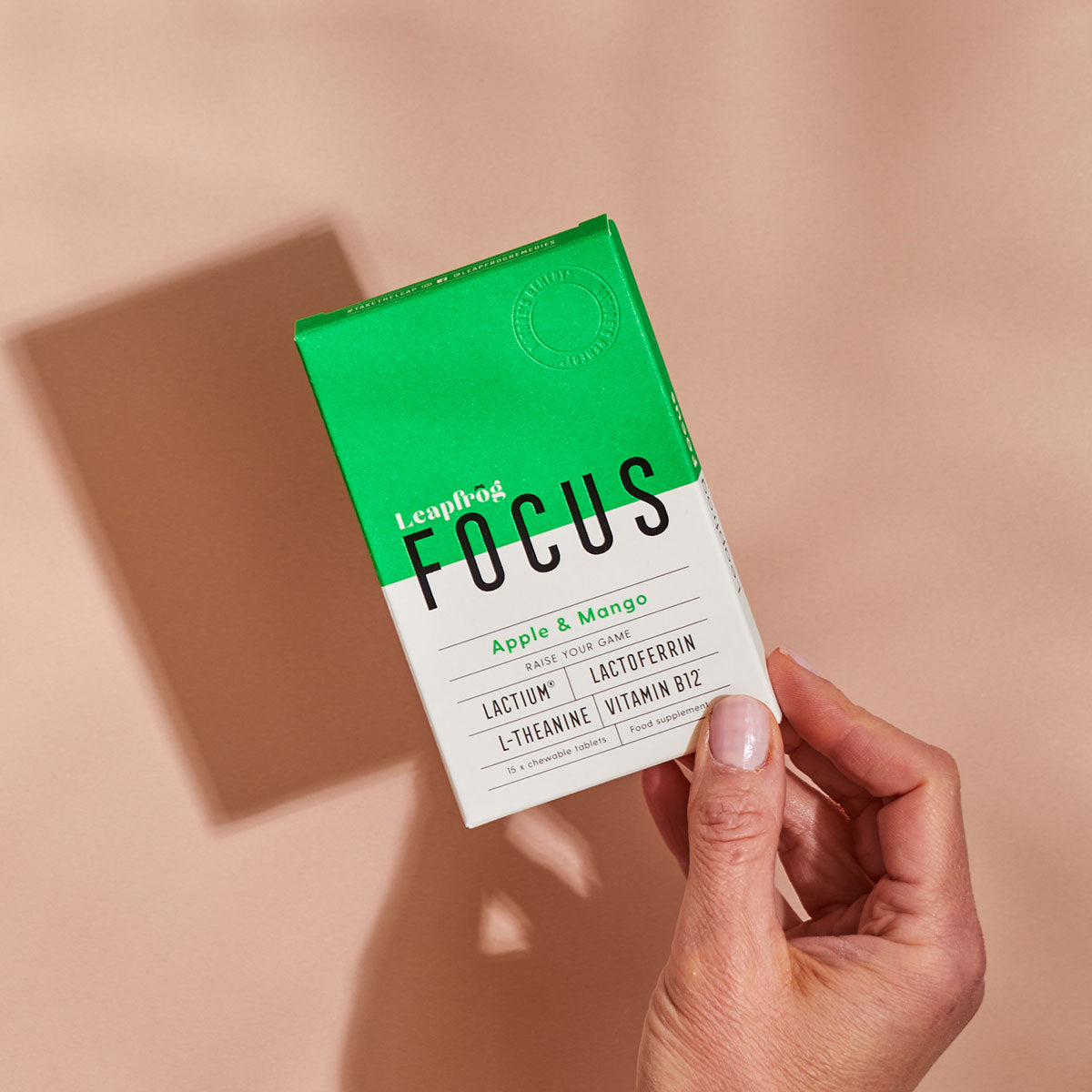
Leapfrog Remedies uses lactoferrin to support mind–body harmony. In Leapfrog FOCUS, lactoferrin is combined with Lactium®, L-Theanine, and Vitamin B12 to promote calm focus, sustained energy, and balanced immunity.
Each chewable tablet works with your body’s natural rhythm, helping you feel clear, composed, and resilient, even during the busiest days.
Click here to order FOCUS
Reference List
Alotiby, A. (2024). Immunology of Stress: A Review Article. Journal of Clinical Medicine, [online] 13(21), pp.6394–6394. doi:https://doi.org/10.3390/jcm13216394.
Burnett, D. (2017). Festive stress: why the Christmas season can be anything but merry. [online] the Guardian. Available at: https://www.theguardian.com/science/brain-flapping/2017/dec/20/festive-stress-why-the-christmas-season-can-be-anything-but-merry.
Dhabhar, F.S. (2014). Effects of Stress on Immune Function: The Good, the Bad, and the Beautiful. Immunologic Research, 58(2-3), pp.193–210. doi:https://doi.org/10.1007/s12026-014-8517-0.
Headspace. (n.d.). 4 Tips For Managing Holiday Stress. [online] Available at: https://www.headspace.com/stress/holiday-stress.
Ishikawa, Y. and Furuyashiki, T. (2021). The impact of stress on immune systems and its relevance to mental illness. Neuroscience Research, [online] 175(175). doi:https://doi.org/10.1016/j.neures.2021.09.005.
Khan, S., Siddique, R., Hao, X., Lin, Y., Liu, Y., Wang, X., Hua, L. and Nabi, G. (2022). The COVID-19 infection in children and its association with the immune system, prenatal stress, and neurological complications. International Journal of Biological Sciences, 18(2), pp.707–716. doi:https://doi.org/10.7150/ijbs.66906.
Kowalczyk, P., Kaczyńska, K., Kleczkowska, P., Bukowska-Ośko, I., Kramkowski, K. and Sulejczak, D. (2022). The Lactoferrin Phenomenon—A Miracle Molecule. Molecules, 27(9), p.2941. doi:https://doi.org/10.3390/molecules27092941.
Siqueiros-Cendón, T., Arévalo-Gallegos, S., Iglesias-Figueroa, B.F., García-Montoya, I.A., Salazar-Martínez, J. and Rascón-Cruz, Q. (2014). Immunomodulatory effects of lactoferrin. Acta Pharmacologica Sinica, 35(5), pp.557–566. doi:https://doi.org/10.1038/aps.2013.200.
Tokiko Shinjo, Keishoku Sakuraba, Atsuko Nakaniida, Ishibashi, T., Kobayashi, M., Aono, Y. and Suzuki, Y. (2018). Oral lactoferrin influences psychological stress in humans: A single‑dose administration crossover study. Biomedical reports. [online] doi:https://doi.org/10.3892/br.2018.1076.
UCL (2022). Depression and anxiety rose sharply over Christmas in the UK. [online] UCL News. Available at: https://www.ucl.ac.uk/news/2022/jan/depression-and-anxiety-rose-sharply-over-christmas-uk.
Wiertsema, S.P., van Bergenhenegouwen, J., Garssen, J. and Knippels, L.M.J. (2021). The Interplay between the Gut Microbiome and the Immune System in the Context of Infectious Diseases throughout Life and the Role of Nutrition in Optimizing Treatment Strategies. Nutrients, 13(3), p.886. doi:https://doi.org/10.3390/nu13030886.