Does Bad Sleep Mean More Coughs and Colds in Kids?
Sleep doesn’t switch your immune system off. During the night, hormones, immune-cell movement and inflammatory signalling continue to change. Although one late night won’t mean a child catches a cold, regularly shortened or disrupted sleep may affect the way the body regulates immune responses, particularly when busy school routines start eating into bedtime.
Much of the detailed research into exactly how sleep affects immunity has been conducted in adults rather than children. The underlying biology helps us understand the connection, but it’s not proof that a particular bedtime will prevent infection.
Sleep and immune communication
A sleeping child looks remarkably inactive. Apart from the occasional turn under the duvet, there’s little to suggest how much is still happening beneath the surface.
Sleep and immunity have a two-way relationship. We see one side of this whenever we become ill: that overwhelming desire to curl up and sleep during an infection isn’t simply exhaustion. Immune cells release signalling proteins called cytokines, some of which communicate with areas of the brain involved in sleep, inflammation and body temperature. Molecules including interleukin-1 (IL-1) and tumour necrosis factor-alpha (TNF-α), for example, participate in inflammatory responses while also influencing sleep regulation.
The conversation works in the opposite direction too. Once we fall asleep, the hormonal and neurological signals reaching immune cells change, while many aspects of immunity follow their own daily, or circadian, rhythms.
This is why describing a child's immune system as simply "strong" or "weak" misses much of the biology. A healthy immune response relies on recognising a potential threat, coordinating the appropriate cells and signals, and controlling that response afterwards. Sleep appears to be one of the many factors involved in keeping these processes appropriately timed.
What happens inside a sleeping body?
One intriguing clue comes from research into T cells, specialised white blood cells involved in recognising infected or abnormal cells and coordinating immune responses. For many immune interactions, T cells need to establish stable physical contact with another cell, which they do partly through adhesion molecules known as integrins.
In a laboratory study of human antigen-specific CD8+ T cells, sleep was associated with greater activation of β2-integrins, which help T cells form stable contacts with other cells. The effect was linked to lower signalling through pathways stimulated by chemical messengers associated with wakefulness, including adrenaline and noradrenaline.
This doesn’t mean that sending a child to bed earlier suddenly makes their T cells better at fighting viruses. The study was conducted in adults, and integrin activation is only one component of a much larger immune process. Instead, it provides an interesting example of how the transition from wakefulness into sleep can alter the molecular behaviour of human immune cells.
The hormonal environment also changes as sleep deepens. During the earlier part of the night, we tend to spend more time in slow-wave sleep, often called deep sleep. Growth hormone secretion is strongly associated with the early part of sleep and the presence of slow-wave sleep, while cortisol is generally relatively low before beginning to rise towards morning.
Because immune cells can detect and respond to hormonal signals, researchers propose that this nighttime environment may support some of the cellular interactions involved in adaptive immune memory, including communication between antigen-presenting cells and T cells.
The immune system, like the brain, can remember previous encounters. After recognising a particular antigen, specialised T and B cells can develop responses that help the body recognise it again, a process that is also central to vaccination.
Adult studies suggest that sleep after vaccination can support antigen-specific T-cell and antibody responses. In one hepatitis A study, participants who slept after vaccination developed stronger antigen-specific T-cell responses than those who remained awake. These findings are biologically interesting, but they don’t mean that one poor night will prevent a child's vaccine from working, and routine vaccination shouldn’t be postponed simply because a child has slept badly.
Can poor sleep mean more colds?
This is probably the question parents most want answered, although the evidence doesn’t give us a simple yes or no.
A systematic review examining sleep and upper respiratory tract infections found that shorter or poorer-quality sleep was associated with a greater likelihood of infections such as colds. However, the studies varied considerably and much of the evidence came from adults rather than children.
In one experimental adult study, researchers monitored participants' sleep before exposing them to rhinovirus, one of the viruses responsible for the common cold. Participants who had been sleeping less were more likely to develop a clinical cold.
There is also some child-specific evidence connecting sleep patterns with inflammatory signalling. In a longitudinal study from the French EDEN birth cohort, researchers examined sleep from approximately ages two to five and measured cytokine concentrations at age five. A shorter sleep-duration trajectory was associated with higher IL-6, while a changing sleep trajectory was associated with higher TNF-α.
Importantly, this was an observational study. It cannot tell us that short sleep directly caused those cytokine differences, particularly because children's sleep is intertwined with many other aspects of health, behaviour and family life.
Taken together, the research suggests that sleep is one of the foundations that supports normal immune function, rather than something that guarantees protection from infection. A child with an excellent sleep routine can still come home with the latest classroom cold.
Why term time quietly steals sleep
School-term sleep loss rarely happens dramatically. More often, it disappears ten or twenty minutes at a time.
Homework takes longer than expected, football finishes late, dinner moves back, someone suddenly remembers what they need for school tomorrow or a conversation with friends continues on a phone. Bedtime gradually shifts later while the morning start time stays exactly where it was.
Those small reductions can add up because children generally need considerably more sleep than adults. The American Academy of Sleep Medicine (AASM) recommends:
|
Age |
Recommended sleep per 24 hours |
|
4-12 months |
12-16 hours, including naps |
|
1-2 years |
11-14 hours, including naps |
|
3–5 years |
10-13 hours, including naps |
|
6-12 years |
9-12 hours |
|
13-18 years |
8-10 hours |
These are recommended ranges for regular sleep rather than rigid targets that must be met perfectly every night.
Getting enough sleep can still be difficult in everyday family life. In the National Sleep Foundation's 2026 parent survey, 44% of children were reported not to consistently meet the recommended sleep duration.
So rather than chasing the perfect bedtime, what can families realistically do?

Five realistic ways to protect sleep during term time
1. Work backwards from the morning. Start with the time your child needs to wake up and work backwards using the recommended sleep range for their age. Remember that time in bed is not necessarily time asleep, so leave some room for winding down and settling.
2. Make morning daylight part of the routine. Morning light is one of the major environmental signals used by the brain to synchronise its internal body clock. Outdoor light is usually the simplest option, whether that comes from walking to school or simply spending a little time outside before leaving. This can be particularly helpful after holidays, when sleep and wake times may have gradually shifted later.
3. Aim for consistency rather than perfection. Keeping sleep and wake times reasonably similar provides predictable signals to the circadian system. A modest weekend lie-in may help a tired child, but very large differences between weekday and weekend sleep can shift the body clock and make Monday morning harder. Protecting enough sleep throughout the week is a more realistic goal than repeatedly trying to catch up at the weekend.
4. Give the brain time to wind down. Screens are often discussed solely in terms of blue light, but their relationship with sleep is more complicated. Evening screen use can combine light exposure with stimulating or emotionally engaging content while also taking up time that might otherwise have been available for sleep. Interactive games and social platforms can be particularly difficult to stop because they encourage continued engagement, so creating some separation between stimulating screen activity and bedtime can help. A bath, reading, talking or simply spending some quieter time together can all provide a gentler transition towards sleep.
5. Remember that sleep starts during the day. Regular movement and outdoor play combine physical activity with natural light exposure, both of which can support healthy sleep patterns. This does not need to mean another organised club; walking, cycling and playing outside all count. Caffeine is also worth watching as children get older because its effects can persist for several hours. Energy drinks are not appropriate for children, and caffeine intake should be limited particularly carefully in adolescents.
Sleep supports more than immunity
Although immunity is our focus here, children's sleep touches almost every aspect of physiology. Research in school-aged children has associated shorter sleep with differences in executive function, behaviour and school performance, although these relationships are generally modest and many other factors contribute.
Shorter sleep has also been associated with a greater risk of childhood overweight and obesity. The explanation is likely to involve interactions between appetite, food intake, physical activity, circadian biology and endocrine regulation rather than a simple change in one or two "hunger hormones".
The same complexity applies to immunity. There is no single immune switch that sleep turns on. Instead, sleep influences several interconnected systems at once, which is precisely why protecting it is worth considering as part of a child's wider health routine.
When poor sleep needs more than a new routine
Occasional difficult nights are a normal part of childhood, but persistent sleep problems deserve attention.
If a child regularly snores loudly, gasps during sleep, appears to have pauses in breathing, frequently breathes through their mouth at night or is unusually sleepy during the day, it is worth discussing these symptoms with a GP or another healthcare professional because they can sometimes be associated with sleep-disordered breathing.
Likewise, if sleep difficulties are persistent or are significantly affecting a child's daytime behaviour, wellbeing or ability to function, professional advice may be more useful than continuing to adjust the bedtime routine alone.
Supporting sleep and immunity together
Sleep will not prevent every cough or cold, and one late night will not switch off a child's immune system. Regular, age-appropriate sleep can, however, help provide the hormonal, circadian and behavioural conditions in which normal immune function takes place.
At Leapfrog Remedies, we see nutritional supplements in much the same way: as one part of a wider routine rather than a replacement for the foundations of children's health.
Leapfrog IMMUNE, suitable from age four, combines lactoferrin, zinc and vitamin C in each chewable tablet. Lactoferrin is a naturally occurring iron-binding protein found in milk and at several mucosal surfaces in the body, where it has been widely studied for its interactions with microbes and the immune system. Zinc and vitamin C both contribute to the normal function of the immune system, making IMMUNE a simple way to add nutritional support alongside sufficient sleep, a varied diet, regular activity, vaccination and appropriate medical care.
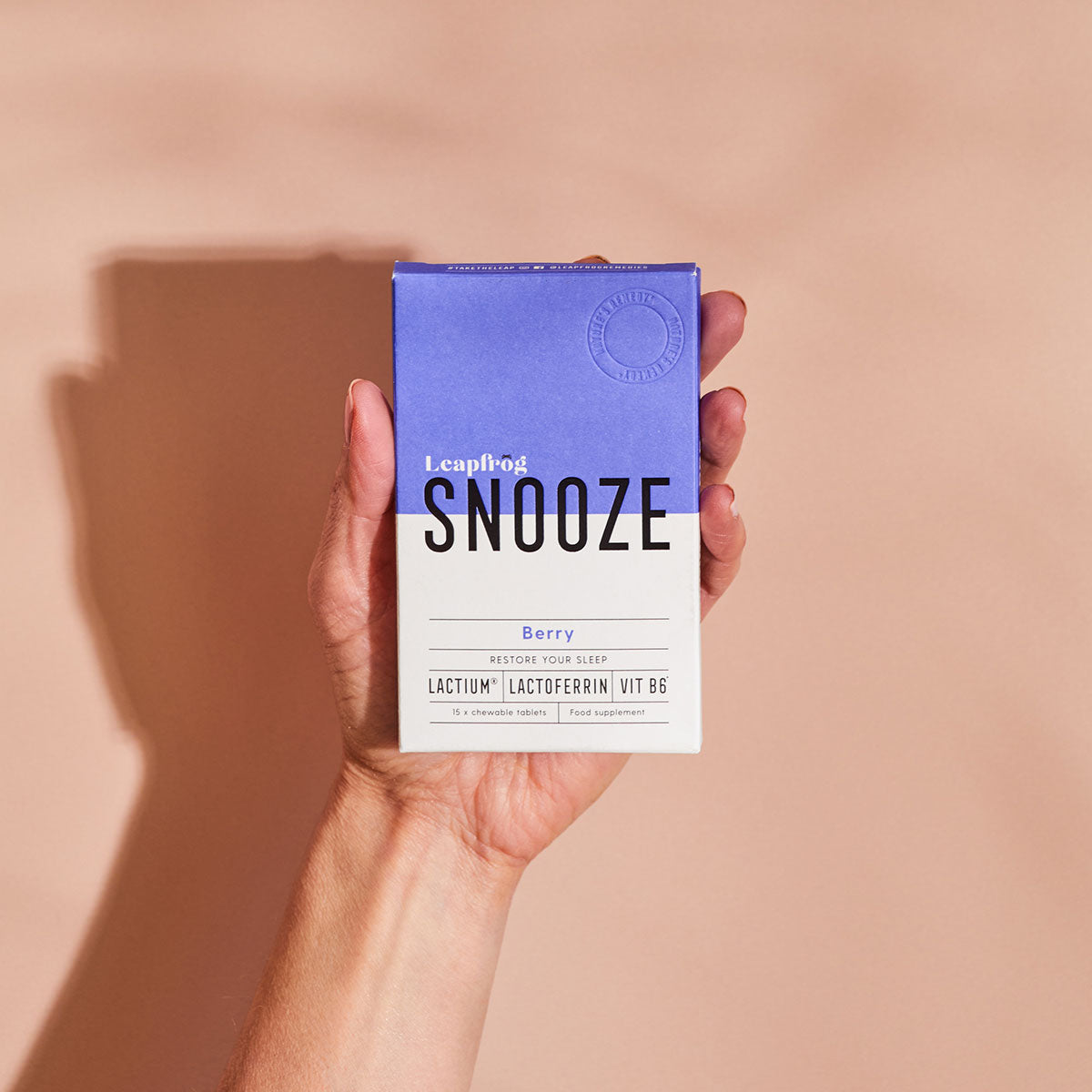
Leapfrog SNOOZE, suitable from age seven, approaches the routine from a different direction. Each chewable tablet contains Lactium®, Lactoferrin and vitamin B6. Lactium® is a milk protein hydrolysate containing the bioactive peptide alpha-casozepine, while vitamin B6 contributes to normal psychological function and the normal functioning of the nervous system.
When school evenings become busy, SNOOZE can become part of a familiar wind-down routine alongside quieter activities, putting screens away and leaving enough time for sleep. It is not a substitute for sufficient sleep itself, just as IMMUNE does not replace the wider foundations of immune health.
During term time, the goal does not need to be a perfect bedtime every night. Protecting enough opportunity for sleep, keeping routines reasonably consistent and giving children time to wind down are much more realistic targets.
Alongside nutritious food, vaccination, hand hygiene and regular movement, sleep is one practical and often overlooked part of supporting children's health throughout the school year.
Reference list
Besedovsky, L., Lange, T. and Born, J. (2011). Sleep and immune function. Pflügers Archiv - European Journal of Physiology, [online] 463(1), pp.121–137. doi:10.1007/s00424-011-1044-0.
Carter, B., Rees, P., Hale, L., Bhattacharjee, D. and Paradkar, M.S. (2016). Association between portable screen-based media device access or use and sleep outcomes: A systematic review and meta-analysis. JAMA pediatrics, [online] 170(12), pp.1202–1208. doi:10.1001/jamapediatrics.2016.2341.
Cohen, S., Doyle, W.J., Alper, C.M., Janicki-Deverts, D. and Turner, R.B. (2009). Sleep habits and susceptibility to the common cold. Arch Intern Med, [online] 169(1), pp.62–67. doi:10.1001/archinternmed.2008.505.
Dimitrov, S., Lange, T., Gouttefangeas, C., Jensen, A.T.R., Szczepanski, M., Lehnnolz, J., Soekadar, S., Rammensee, H.-G., Born, J. and Besedovsky, L. (2019). Gαs-coupled receptor signaling and sleep regulate integrin activation of human antigen-specific T cells. Journal of Experimental Medicine, 216(3), pp.517–526. doi:10.1084/jem.20181169.
Garbarino, S., Lanteri, P., Bragazzi, N.L., Magnavita, N. and Scoditti, E. (2021). Role of sleep deprivation in immune-related disease risk and outcomes. Communications Biology, 4(1). doi:10.1038/s42003-021-02825-4.
Gellner, C. (2018). Three Health Risks when kids don’t get enough quality sleep. [online] University of Utah Health | University of Utah Health. Available at: https://healthcare.utah.edu/the-scope/kids-zone/all/2023/09/three-health-risks-when-kids-dont-get-enough-quality-sleep [Accessed 22 Sept. 2026].
Lange, T., Dimitrov, S., Bollinger, T., Diekelmann, S. and Born, J. (2011). Sleep after vaccination boosts immunological memory. The Journal of Immunology, 187(1), pp.283–290. doi:10.4049/jimmunol.1100015.
Lv, T., Yao, J., Guo, C. and Liao, L. (2026). The effect of insufficient sleep on lymphocytes —Recent literature review. Sleep Medicine, 148, p.109189. doi:10.1016/j.sleep.2026.109189.
National Sleep Foundation (2026). Here’s something your kid’s mood, grades, and immunity have in common. [online] National Sleep Foundation. Available at: https://www.thensf.org/heres-something-your-kids-mood-grades-and-immunity-have-in-common/ [Accessed 22 Sept. 2026].
Paruthi, S., Brooks, L.J., D’Ambrosio, C., Hall, W.A., Kotagal, S., Lloyd, R.M., Malow, B.A., Maski, K., Nichols, C., Quan, S.F., Rosen, C.L., Troester, M.M. and Wise, M.S. (2016). Consensus statement of the American Academy of Sleep Medicine on the recommended amount of sleep for healthy children: Methodology and discussion. Journal of Clinical Sleep Medicine, 12(11), pp.1549–1561. doi:10.5664/jcsm.6288.
Radmanish, M., Khalfallah, O., Glaichenhaus, N., Forhan, A., Heude, B., Charles, M.-A., Davidovic, L. and Plancoulaine, S. (2022). Sleep duration trajectories associated with levels of specific serum cytokines at age 5: A longitudinal study in preschoolers from the EDEN birth cohort. Brain, Behavior, & Immunity - Health, 21, p.100429. doi:10.1016/j.bbih.2022.100429.
Robinson, C.H., Albury, C., McCartney, D., Fletcher, B., Roberts, N., Jury, I. and Lee, J. (2021). The relationship between duration and quality of sleep and upper respiratory tract infections: A systematic review. Family Practice, 38(6), pp.802–810. doi:10.1093/fampra/cmab033.
Waggoner, S.N. (2020). Circadian Rhythms in Immunity. Current Allergy and Asthma Reports, 20(1). doi:10.1007/s11882-020-0896-9.