Perimenopause and Sleep: How Hormones Affect a Night's Rest
We tend to think of oestrogen and progesterone as the hormones responsible for our periods, pregnancy and fertility. But what we hear far less about is how these same hormones influence our brains, from the way we regulate body temperature to how easily we fall asleep and stay asleep. It's a connection that becomes particularly relevant during perimenopause, when changing hormone levels can start affecting parts of everyday life we might never have associated with our reproductive system.
Sleep is a good example. Many women notice their nights becoming more disrupted during their 40s and 50s, sometimes before experiencing the hot flushes or irregular periods we typically associate with menopause. You might find yourself waking more frequently, struggling to drift off again or feeling surprisingly tired despite spending your usual eight hours in bed. And while it's easy to blame stress or getting older, the hormonal changes happening during perimenopause may have something to do with it.
So, what's happening to your hormones?
Hormones are chemical messengers that travel around the body, carrying signals between different organs and tissues. Two of the main reproductive hormones are oestrogen and progesterone, both produced primarily by the ovaries. Oestrogen helps regulate the menstrual cycle, supports bone health and influences areas of the brain involved in mood, body temperature and sleep. Progesterone is mainly produced after ovulation, helping prepare the uterus for a potential pregnancy, but it also has effects on the brain.
Throughout our reproductive years, these hormones rise and fall in a relatively predictable pattern. But during perimenopause, ovulation becomes less regular, meaning progesterone isn't produced as consistently, while oestrogen levels can fluctuate considerably before eventually declining. Another hormone involved is follicle-stimulating hormone (FSH), which is released by the pituitary gland at the base of the brain to stimulate the ovaries. As the ovaries become less responsive during perimenopause, FSH levels generally rise.
These changes don't just affect your periods. They may also influence the brain systems involved in regulating sleep, helping explain why restless nights become increasingly common during this stage of life. For many women, the problem isn't necessarily falling asleep, but staying asleep, with more frequent awakenings and longer periods spent awake during the night. This is known as sleep maintenance insomnia, and it can leave you feeling exhausted even when you've spent your usual amount of time in bed.

Oestrogen, night sweats and disrupted sleep
One of the best-known effects of changing oestrogen levels is the appearance of hot flushes and night sweats. This happens because oestrogen influences the hypothalamus, a small region of the brain that helps regulate body temperature. As oestrogen levels change, the brain can become more sensitive to small increases in temperature, triggering sweating and increased blood flow to the skin to help cool the body down. It's not particularly helpful when you're trying to sleep, especially since our core body temperature naturally falls as we prepare for bed.
But what if you're waking up throughout the night without experiencing night sweats? Oestrogen also interacts with brain pathways involved in sleep and wakefulness. Changes in oestradiol, the main form of oestrogen during our reproductive years, have been linked to more fragmented sleep, including more frequent awakenings and longer periods spent awake during the night.
These associations aren't always explained by hot flushes or mood changes, suggesting that hormonal fluctuations may influence sleep in other ways too. Although researchers are still exploring exactly how this works, it may help explain why some women notice their sleep changing before experiencing other symptoms of perimenopause.
Progesterone and the brain's calming system
While oestrogen tends to get most of the attention during menopause, progesterone has an interesting relationship with sleep too. In fact, its influence extends beyond the reproductive system and into the chemistry of the brain itself.
When progesterone is broken down in the body, it produces a substance called allopregnanolone, which interacts with receptors for GABA, one of the brain's main chemical messengers, also known as neurotransmitters. GABA helps reduce excessive activity between nerve cells, while allopregnanolone can enhance this calming effect. It's one reason progesterone has attracted interest for its potential influence on relaxation and sleep.
During perimenopause, progesterone production becomes less predictable as ovulation occurs less frequently. Although we're still learning exactly how these changes affect sleep, there is some interesting clinical evidence suggesting that progesterone itself may help improve certain aspects of sleep quality.
In particular, micronised progesterone, a prescription form of progesterone designed to be absorbed by the body, has been associated with improvements in sleep in some clinical trials. These include spending less time awake after falling asleep and, in certain studies, improvements in slow-wave sleep, the deepest stage of non-REM sleep. This stage is involved in processes such as physical recovery and memory consolidation, making it an important part of a restorative night's rest.
The strongest evidence comes from studies involving postmenopausal women, so we can't assume the same benefits apply to everyone going through perimenopause. It's also worth distinguishing micronised progesterone from synthetic progestogens, which don't necessarily have identical effects on sleep.
Nevertheless, this research adds another dimension to our understanding of progesterone. Rather than being involved only in preparing the uterus for pregnancy, it also produces substances that interact with the brain systems responsible for regulating how alert or relaxed we feel.
And hormones aren't the only thing influencing our sleep. Stress, anxiety and changes in our circadian rhythm, the internal body clock that helps regulate when we feel sleepy, can also play a part. During perimenopause, several of these factors may overlap, making it difficult to identify one particular cause.
What can help you sleep better during perimenopause?
When hormonal changes are affecting your sleep, being told to put your phone away or avoid coffee after lunch can feel a little frustrating. Those habits can help, but they don't necessarily address what's happening in your body.
For persistent insomnia, cognitive behavioural therapy for insomnia (CBT-I) is one of the most effective treatments, helping address the thoughts and habits that can keep sleep problems going. Hormone replacement therapy (HRT) may also improve sleep for some women, particularly when hot flushes and night sweats are involved. Depending on individual circumstances, treatment may include oestrogen and progesterone, with micronised progesterone sometimes offering additional sleep-related benefits. These are prescription treatments, so the most appropriate approach should always be discussed with a healthcare professional.
Alongside these approaches, there's growing interest in whether certain nutritional ingredients can support sleep quality, especially when stress or difficulty relaxing is part of the problem.
One example is Lactium®, a milk-derived protein hydrolysate containing peptides from alpha-s1-casein. It has been studied for its potential effects on stress and sleep, with some clinical trials reporting improvements in measures such as sleep duration, sleep efficiency and time spent awake during the night. Although these findings are encouraging, the research is still relatively limited, and Lactium® hasn't been established as a treatment for sleep disturbances specifically caused by perimenopause.
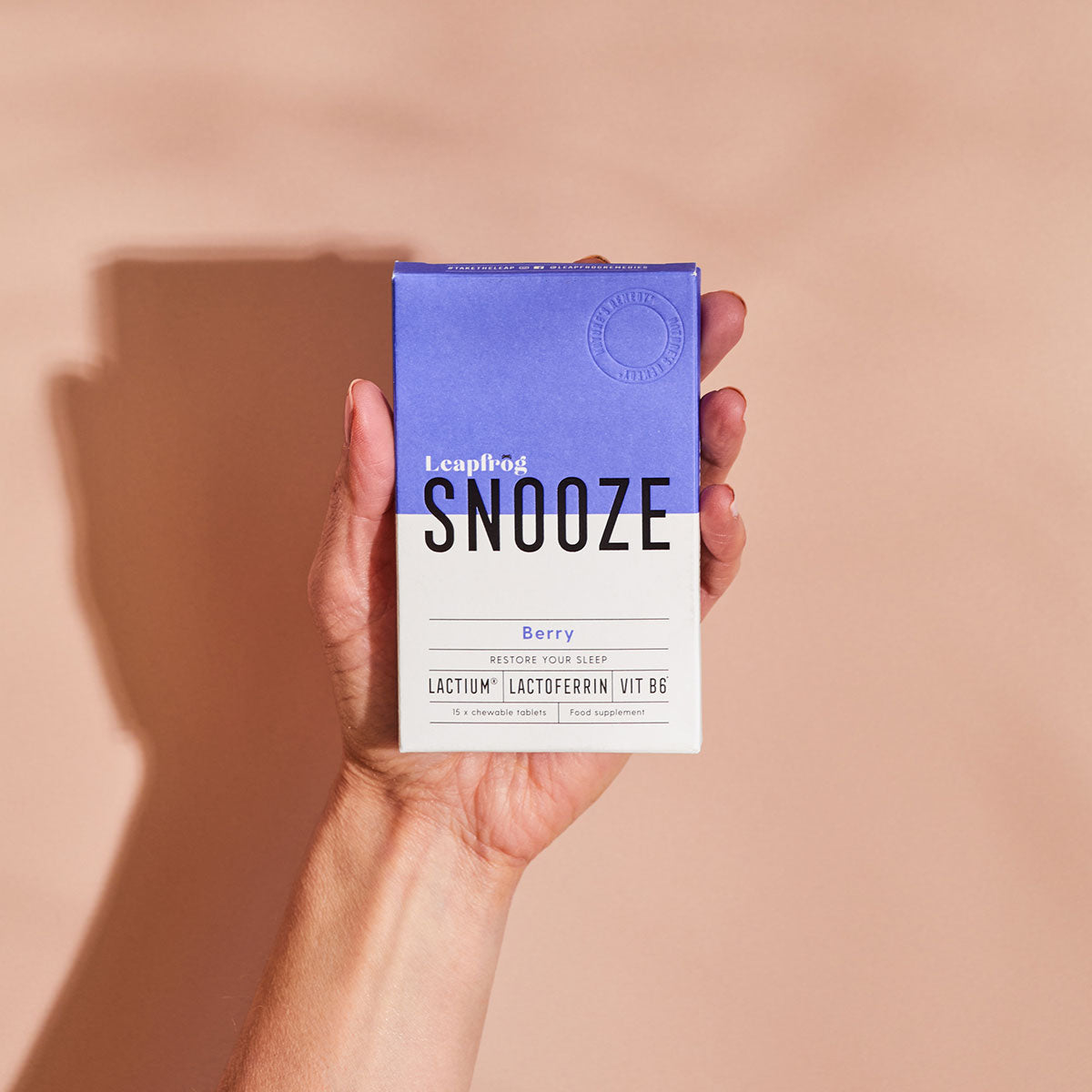
Lactium® is one of the ingredients in Leapfrog's SNOOZE, alongside lactoferrin and vitamin B6. Designed to complement an evening wind-down routine, SNOOZE offers a way to incorporate Lactium® into your bedtime habits, although it won't address the hormonal fluctuations themselves.
Ultimately, improving sleep during perimenopause often comes down to understanding what's disrupting it. For some women, managing night sweats may make the biggest difference, while others may benefit from addressing stress, insomnia or an underlying sleep condition. If poor sleep is becoming a regular problem, it's worth speaking to your GP rather than simply accepting it as part of getting older.
We're still learning about the relationship between reproductive hormones and sleep, but one thing is becoming clearer: oestrogen and progesterone do far more than regulate our menstrual cycles. Their influence reaches into many of the processes we rely on every day, including getting a good night's rest.
Reference list
Caufriez, A., Leproult, R., L’Hermite-Balériaux, M., Kerkhofs, M. and Copinschi, G. (2011). Progesterone prevents sleep disturbances and modulates GH, TSH, and melatonin secretion in postmenopausal women. The Journal of Clinical Endocrinology and Metabolism, [online] 96(4), pp.E614–623. doi:10.1210/jc.2010-2558.
Chang, C.-M., Tsai, I.-J., Yang, C.-C., Liu, W.-C. and Yang, C.-P. (2024). The impact of Alpha-s1 casein hydrolysate on chronic insomnia: A randomized, double-blind controlled trial. Clinical Nutrition, [online] 43(12), pp.275–284. doi:10.1016/j.clnu.2024.10.039.
Coborn, J., de Wit, A., Crawford, S., Nathan, M., Rahman, S., Finkelstein, L., Wiley, A. and Joffe, H. (2022). Disruption of sleep continuity during the perimenopause: Associations with female reproductive hormone profiles. The Journal of Clinical Endocrinology & Metabolism, [online] 107(10), pp.e4144-e4153. doi:10.1210/clinem/dgac447.
Haufe, A., Baker, F.C. and Leeners, B. (2022). The role of ovarian hormones in the pathophysiology of perimenopausal sleep disturbances: A systematic review. Sleep Medicine Reviews, 66, p.101710. doi:10.1016/j.smrv.2022.101710.
Haufe, A. and Leeners, B. (2023). Sleep disturbances across a woman’s lifespan: What is the role of reproductive hormones? Journal of the Endocrine Society, 7(5). doi:10.1210/jendso/bvad036.
Nolan, B.J., Liang, B. and Cheung, A.S. (2020). Efficacy of micronized progesterone for sleep: A systematic review and meta-analysis of randomized controlled trial data. The Journal of Clinical Endocrinology & Metabolism, 106(4), pp.e942-e951. doi:10.1210/clinem/dgaa873.
Troìa, L., Garassino, M., Volpicelli, A.I., Fornara, A., Libretti, A., Surico, D. and Remorgida, V. (2025). Sleep disturbance and perimenopause: A narrative review. Journal of Clinical Medicine, 14(5), p.1479. doi:10.3390/jcm14051479.