September Sleep Reset: Why Now Is a Good Time to Rebuild Your Sleep Routine
September has a particular kind of reset energy with the summer holidays begin to wind down, mornings become more structured and daily life starts to regain a little predictability. While January is often treated as the natural time for new habits, September can be a practical moment to rebuild a more consistent sleep routine.
It is not because September itself is biologically better for sleep, or because the change of season can magically fix insomnia. Sleep is influenced by many things, including stress, health, work, family life, temperature, light and individual circadian preference. However, the return of cooler nights, more predictable daily schedules and changing light exposure can provide useful cues for realigning sleep timing and protecting sleep quality, provided the routine is realistic and maintained.
If your sleep has felt slightly out of rhythm over the summer, September offers a natural opportunity to make a few small changes before autumn becomes busier.
Cooler nights can help
Sleep and body temperature are closely connected. In the hours before sleep, the body normally begins to lose heat, with blood flow increasing towards the skin, particularly through the hands and feet. This process, known as distal vasodilation, helps move heat away from the body's core and supports the gradual fall in core body temperature that accompanies the transition into sleep.
When the bedroom is excessively warm, humid or poorly ventilated, releasing heat becomes more difficult. Research consistently links higher temperatures with shorter sleep and more disrupted sleep, with REM sleep appearing particularly vulnerable to thermal discomfort.
There is no universal "perfect" bedroom temperature because bedding, sleepwear, humidity, ventilation, age, acclimatisation and personal preference all influence thermal comfort. A useful aim is simply to keep your bedroom comfortably cool, well ventilated and free from that stuffy feeling. Many UK sleep resources suggest somewhere around 16 to 18°C as a useful starting point, but the best temperature is ultimately one that feels comfortably cool to you rather than uncomfortably cold.
After a summer of throwing the duvet off at 3am or waking up feeling overheated, cooler September nights can make it easier for your body to carry out this natural cooling process.
Darkness is a sleep signal
Light is one of the strongest external signals used to synchronise the circadian clock. During the evening, falling light levels allow melatonin secretion to rise, helping the body transition towards sleep. Bright light exposure later in the evening can have the opposite effect, suppressing melatonin and delaying circadian timing, particularly when the exposure is bright, prolonged or close to bedtime.
As September progresses and the evenings become darker earlier, there is an opportunity to strengthen the contrast between daytime alertness and nighttime rest. This does not mean that autumn darkness automatically improves sleep, particularly if your evenings are still filled with bright lights, television and late-night scrolling.
Instead, think about gradually changing the lighting around you as bedtime approaches. In the one to two hours before bed, make your environment noticeably dimmer than it is during the day by reducing bright overhead lighting and avoiding prolonged, close-up exposure to bright devices where possible. You do not need to sit in darkness all evening, and there is no need to ban screens completely. The aim is simply to create a gradual reduction in light and stimulation that gives your body a clearer signal that the day is winding down.
Morning light matters too. Getting outside in natural daylight soon after waking can help anchor the circadian system and reinforce the difference between day and night, particularly when paired with a reasonably consistent wake time.
September brings something else your sleep needs: routine
Summer can make life wonderfully unpredictable, but sleep tends to appreciate a little more structure. Holidays, late evenings, lie-ins, travel and changes to your usual routine can all shift the timing of sleep and waking. Occasional changes are completely normal, but if your schedule has drifted significantly, returning to regular daily cues can help bring your sleep pattern back into line.
September naturally provides many of these anchors. Work schedules become more predictable, schools and universities return, commutes begin again and the general rhythm of daily life starts to settle. These regular cues can help the circadian system establish a clearer pattern of when to promote alertness and when to prepare for sleep.
Start with a consistent wake time. Keeping your wake time reasonably stable across the week helps anchor the circadian system and builds sleep pressure across the day. From there, allow yourself enough opportunity for sleep. Most adults need at least seven hours regularly, although individual sleep requirements vary, so the goal is not to force yourself into an arbitrary bedtime but to create enough time for your body to get the sleep it needs.
If your sleep has drifted during the summer, avoid trying to correct everything at once. A consistent wake time, morning daylight and a calmer evening routine are often more useful than suddenly deciding that you must be in bed several hours earlier.
Stress, cortisol and sleep
Cortisol is often called the "stress hormone", but that description is incomplete. It is an essential hormone involved in metabolism, immune function and the daily regulation of alertness. Cortisol follows a strong 24-hour rhythm, with levels generally low during the early part of the night before rising during the latter part of sleep and reaching a peak around the time we wake.
This rhythm helps coordinate alertness during the day and recovery at night. The problem is not cortisol itself, but what happens when stress and arousal make it difficult for the body and mind to shift into a restful state in the evening.
Research has associated higher cortisol before sleep with taking longer to fall asleep, shorter total sleep and lower sleep efficiency. Higher levels of physical and cognitive arousal before bed are also associated with poorer sleep, which helps explain why a busy mind can keep you awake even when you are physically tired.
The relationship works in both directions. Significant or repeated sleep restriction can affect the normal daily pattern of cortisol, with some research finding higher levels later in the day and a flatter decline towards evening. However, the response varies according to factors such as the amount and timing of sleep loss, individual characteristics and the study design, so it is more accurate to talk about changes in cortisol timing and heightened arousal than simply saying that poor sleep causes "high cortisol".
The goal is certainly not to eliminate cortisol; your body needs it. What we want to support is the normal transition from daytime alertness into evening recovery, and regular sleep timing, appropriate light exposure, a comfortable sleep environment and a calming wind-down can all contribute to that process.

Why one bad night can turn into a pattern
Anyone who has experienced a run of poor sleep will recognise how quickly the worry about sleep itself can become part of the problem. After a restless night, you may feel tired, irritable and less able to deal with everyday stress. By evening, you may already be thinking about whether you will sleep better tonight, checking the clock or trying to force yourself to fall asleep.
That pressure can increase mental and physical arousal at precisely the time you want them to settle. You become more aware of every sensation, every sound and every minute that passes, making sleep feel like something you have to achieve rather than something your body naturally does.
This is one reason why the September reset should be about consistency rather than perfection. The aim is not to create a flawless bedtime routine that falls apart the first time you have a late night. It is to establish enough regular cues that your body begins to recognise when it is time to be awake and when it is time to rest.
Your September sleep reset
The best sleep routine is one you can actually maintain. Instead of attempting a complete lifestyle overhaul, focus on a few habits that reinforce one another.
Start by choosing a wake time that you can maintain most days. Get some natural morning light where possible, ideally by spending time outside, and use the increasing darkness of the evening as a cue to gradually reduce light and stimulation.
Create a simple wind-down routine that you genuinely enjoy. This could involve reading, gentle stretching, listening to music, taking a shower or simply putting your phone away and giving yourself some quiet time. The important thing is that the routine is familiar and calming rather than another task you feel you have to complete perfectly.
Keep your bedroom comfortably cool, dark, quiet and well ventilated, particularly while temperatures remain mild. Limit caffeine later in the day and be mindful of alcohol, which can make sleep more fragmented even when it initially makes you feel sleepy.
If you have a poor night, try not to compensate with a very long lie-in, an unusually early bedtime or hours spent awake in bed. Keep your wake time broadly consistent, get some daylight during the morning and return to bed when you feel sleepy. Clock-watching can also increase anxiety around sleep, so if you find yourself repeatedly checking the time, consider turning the clock away.
These are simple changes, but their strength comes from repetition. Your body clock responds to patterns rather than one perfect night.
Why September can be a useful reset point
There is something psychologically useful about September too. It has some of the same "fresh start" energy that makes January so appealing, but without the pressure of making dramatic resolutions.
The return to work, school or university can create regular anchor points throughout the day, while cooler nights and earlier darkness can make it easier to create an environment that supports sleep. None of these factors guarantees better sleep, but together they can make September a practical time to rebuild habits that may have slipped during the summer.
Think of it less as a seasonal sleep hack and more as a convenient opportunity to reset your routine.
You do not need to wait until January to decide that sleep deserves more attention. Establishing a consistent wake time, getting daylight in the morning, reducing evening light, creating a calming wind-down and making your bedroom comfortable can give you a stronger foundation for the months ahead.
Where SNOOZE fits in
At Leapfrog Remedies, we believe good sleep is about creating the right conditions rather than searching for one magic solution. Your environment, light exposure, daily schedule, stress levels and evening routine all play a role in preparing your body and mind for rest.
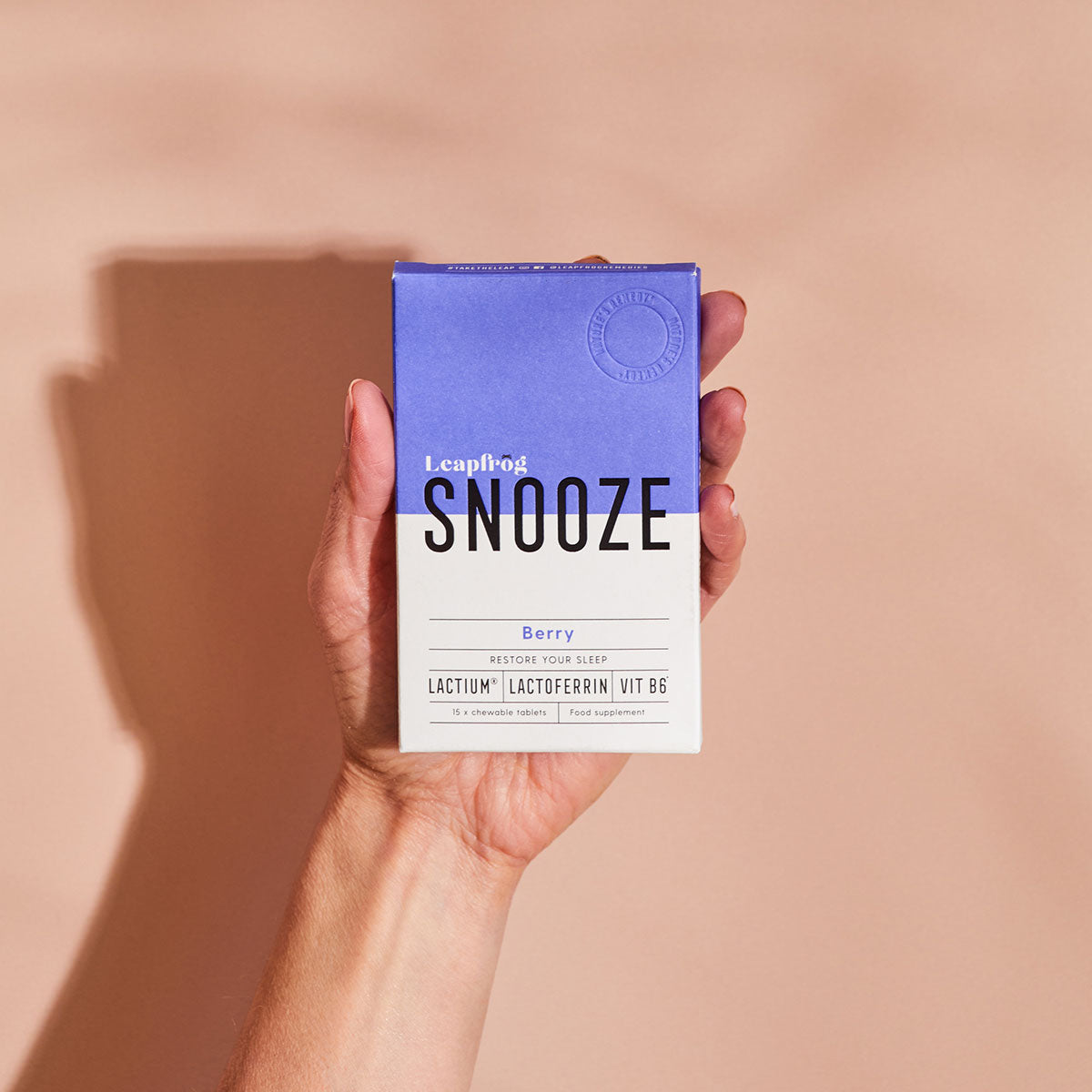
SNOOZE can naturally become part of that evening routine. It contains Lactium®, a milk protein hydrolysate that has been studied in human trials for its potential effects on sleep quality and relaxation, alongside lactoferrin and vitamin B6.
Vitamin B6 also contributes to normal psychological function and the normal functioning of the nervous system, provided the finished product meets the relevant conditions of use for these authorised nutrition claims.
The aim is not to force sleep, but to create a familiar evening environment in which sleep can happen naturally. September is a useful time to establish that rhythm because the cooler nights, changing light and return to routine can all provide helpful cues.
And unlike a short-term summer fix, a good evening routine does not need to disappear when the seasons change. The habits you build now can carry you through autumn and winter, giving your body a consistent framework for sleep long after the summer has gone.
When to seek extra support
If poor sleep is becoming persistent, affecting your ability to function during the day or causing significant distress, it is worth speaking to a healthcare professional rather than simply trying to push through it. Persistent insomnia can have many causes, and evidence-based approaches such as cognitive behavioural therapy for insomnia, or CBT-I, can be highly effective.
Similarly, if anxiety is becoming difficult to manage, seeking appropriate support is important. A supplement can be part of a wider wellbeing routine, but it should not be positioned as a treatment for a diagnosed sleep or mental health condition.
September does not have to be the month when you suddenly become a perfect sleeper. It can simply be the month when you start giving your body more consistent signals about when to wake, when to wind down and when to rest. Sometimes, that is the reset that matters most.
Reference list
Altena, E., Baglioni, C., Sanz-Arigita, E.J., Cajochen, C. and Riemann, D. (2022). How to deal with sleep problems during heatwaves: Practical recommendations from the <SCP>European</scp> insomnia network. Journal of sleep research, 32(2). doi:10.1111/jsr.13704.
Blume, C., Garbazza, C. and Spitschan, M. (2019). Effects of light on human circadian rhythms, sleep and mood. Somnology : Sleep Research and Sleep Medicine, [online] 23(3), pp.147–156. doi:10.1007/s11818-019-00215-x.
Cajochen, C., Stefani, O., Schöllhorn, I., Lang, D. and Chellappa, S. (2022). Influence of evening light exposure on polysomnographically assessed night-time sleep: A systematic review with meta-analysis. Lighting Research & Technology, p.147715352210787. doi:10.1177/14771535221078765.
Edinger, J.D., Arnedt, J.T., Bertisch, S.M., Carney, C.E., Harrington, J.J., Lichstein, K.L., Sateia, M.J., Troxel, W.M., Zhou, E.S., Kazmi, U., Heald, J.L. and Martin, J.L. (2021). Behavioral and psychological treatments for chronic insomnia disorder in adults: An American Academy of Sleep Medicine Clinical Practice Guideline. Journal of Clinical Sleep Medicine, [online] 17(2), pp.255–262. doi:10.5664/jcsm.8986.
Leproult, R., Copinschi, G., Buxton, O. and Van Cauter, E. (1997). Sleep loss results in an elevation of cortisol levels the next evening. Sleep, 20(10). doi:10.1093/sleep/20.10.865.
Liu, P.Y. (2024). Rhythms in cortisol mediate sleep and circadian impacts on health. SLEEP, 47(9). doi:10.1093/sleep/zsae151.
Sletten, T.L., Weaver, M.D., Foster, R.G., Gozal, D., Klerman, E.B., Rajaratnam, S.M.W., Roenneberg, T., Takahashi, J.S., Turek, F.W., Vitiello, M.V., Young, M.W. and Czeisler, C.A. (2023). The importance of sleep regularity: A consensus statement of the National Sleep Foundation Sleep timing and variability panel. Sleep Health, [online] 9(6). doi:10.1016/j.sleh.2023.07.016.
Togo, F., Aizawa, S., Arai, J., Yoshikawa, S., Ishiwata, T., Shephard, R.J. and Aoyagi, Y. (2007). Influence on human sleep patterns of lowering and delaying the minimum core body temperature by slow changes in the thermal environment. Sleep, 30(6), pp.797–802. doi:10.1093/sleep/30.6.797.
Watson, N.F. and Badr, M.S. (2015). Recommended amount of sleep for a healthy adult: A joint consensus statement of the American academy of sleep medicine and sleep research society. Sleep, [online] 38(6), pp.843–844. doi:10.5665/sleep.4716.